











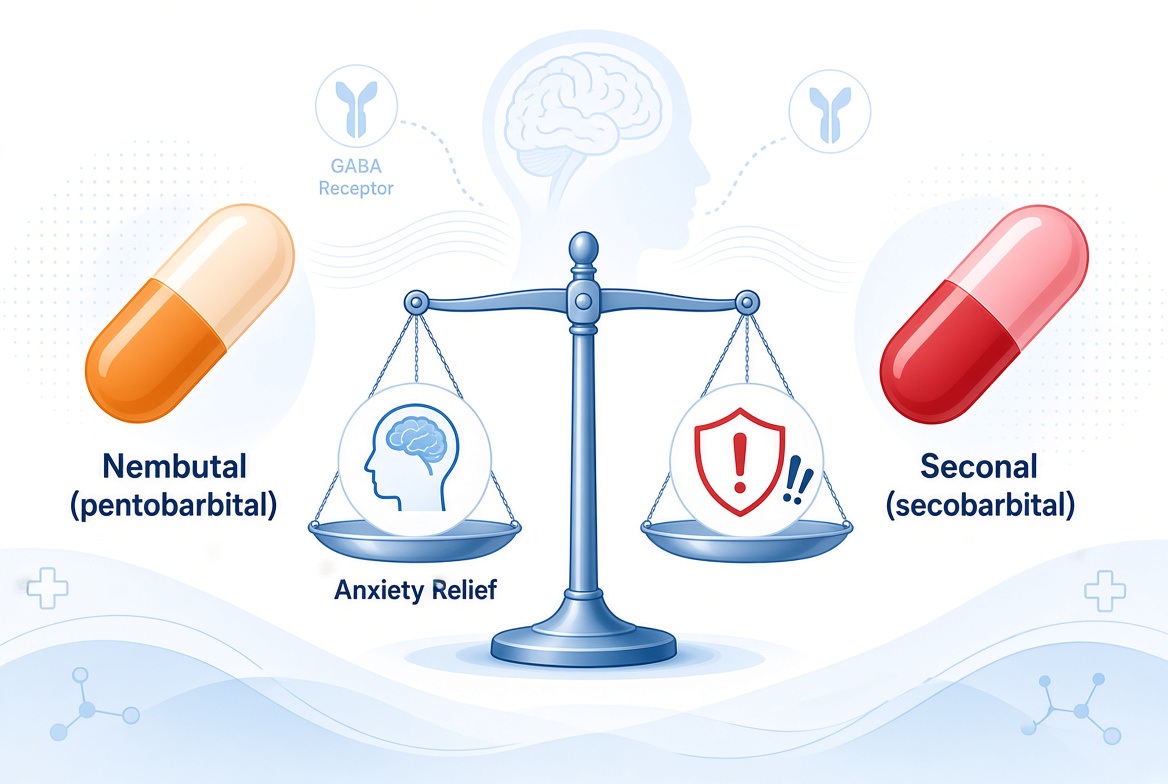
People searching for “Nembutal vs Seconal” often want to know which of these older barbiturates works better for anxiety. The short, evidence-based answer is that neither is a recommended treatment for anxiety in modern medicine.
Both drugs belong to the barbiturate class and were once used for sedation and short-term anxiety or insomnia relief. They have been largely superseded by benzodiazepines, SSRIs, SNRIs, and non-drug therapies because of their narrow therapeutic index, high overdose risk, and dependence potential.
What Are Nembutal and Seconal?
- नेम्ब्यूटल is the brand name for पेंटोबार्बिटल, a short-acting barbiturate.
- Seconal is the brand name for secobarbital, also a short-acting barbiturate.
Both enhance the activity of the inhibitory neurotransmitter GABA at GABA-A receptors, producing dose-dependent central nervous system depression that ranges from mild sedation to deep anesthesia and respiratory depression.
Historically they were prescribed for:
- Short-term treatment of insomnia
- Preoperative sedation and anxiety reduction
- Emergency control of certain seizures (especially pentobarbital)
Oral capsule forms of Nembutal were discontinued in the United States years ago; injectable pentobarbital remains available for specific hospital uses. Secobarbital (Seconal) has similarly limited availability and is rarely used for routine anxiety or sleep.
Nembutal vs Seconal: Side-by-Side Comparison
| विशेषता | Nembutal (Pentobarbital) | Seconal (Secobarbital) |
|---|---|---|
| Classification | Short-acting barbiturate | Short-acting barbiturate |
| Typical historical uses | Insomnia, pre-op sedation, seizures, intracranial pressure | Insomnia, pre-op sedation/anxiolysis |
| Onset (oral) | ~10–15 minutes | ~10–15 minutes |
| Duration | Roughly 3–6 hours | Roughly 3–6 hours |
| Current primary roles | Hospital: status epilepticus, induced coma, limited other uses | Very limited; historically higher abuse association |
| Schedule (US) | सूची II | सूची II |
The two drugs are pharmacologically very similar. Controlled studies and clinical reviews do not establish one as clearly superior to the other for anxiety relief. Differences in lipid solubility and metabolism exist but are modest in practice for the indications they once shared.
Why Barbiturates Are No Longer Preferred for Anxiety
Barbiturates can reduce anxiety through general CNS depression, but they carry important drawbacks:
- Narrow therapeutic index — the dose that calms is uncomfortably close to the dose that causes serious respiratory depression.
- High risk of physical dependence and difficult withdrawal (which can include seizures).
- Significant interaction risk with alcohol and other CNS depressants.
- Rapid development of tolerance for the sedative and hypnotic effects.
- Higher fatal toxicity rates historically compared with benzodiazepines.
By the 1960s–1970s, benzodiazepines largely replaced barbiturates for anxiety and insomnia because they have a wider safety margin and lower risk of lethal overdose when used alone. Current guidelines and clinical practice reserve short-acting barbiturates for highly specific, usually inpatient, situations rather than outpatient anxiety management.
Modern Approaches to Anxiety Relief
Evidence-based first-line options for generalized anxiety and related disorders typically include:
- Selective serotonin reuptake inhibitors (SSRIs) and serotonin-norepinephrine reuptake inhibitors (SNRIs)
- Cognitive behavioral therapy (CBT) and other psychotherapies
- Short-term benzodiazepines in carefully selected cases (still preferred over barbiturates when a rapid-acting agent is needed)
- Lifestyle and non-pharmacologic strategies
A healthcare professional can determine the most appropriate approach based on individual history, other medications, and co-occurring conditions.
Important Safety and Legal Notes
Both Nembutal and Seconal are tightly controlled Schedule II substances in the United States. Unauthorized possession, use, or distribution is illegal. These drugs have been associated with recreational misuse and, in high doses, fatal respiratory arrest. They are not appropriate for self-medication.
This article is for informational purposes only and does not constitute medical advice. Always consult a licensed physician or qualified healthcare provider before considering any medication for anxiety or any other condition. Never obtain or use controlled substances outside of a legitimate prescription and medical supervision.

